
Industry Knowledge Hub

Garment Manufacturing Insights

Stay Updated with Apparel Sourcing, Textile Innovations & Export Trends

0%

Global buyers are rethinking how they source Blended Fabric Clothing. Cotton-polyester shirts, viscose-spandex dresses, and recycled-fiber uniforms now compete on comfort, durability, cost, and environmental performance. The right supplier must manage all four.

Dr. Seshadri Ramkumar, a textile technology professor and industry researcher, often emphasizes, “Sustainability is not a destination, but a journey.” His view fits blended fabrics well. A blend may reduce wrinkling, improve stretch, or extend garment life. Yet recycling can become difficult when different fibers are combined. That detail is easy to overlook.

This guide introduces leading Blended Fabric Clothing suppliers for international buyers. It examines manufacturing experience, fabric composition, quality systems, production capacity, and communication practices. Buyers should request laboratory reports, colorfastness results, shrinkage data, and pre-production samples. A factory photograph is not enough.

Look closely at the sewing floor.

Reliable suppliers explain their minimum order quantities clearly. They also identify fiber percentages, finishing treatments, packaging methods, and delivery limitations. Certifications can support trust, but they do not replace independent verification. Buyers should still inspect records and test samples.

The best supplier may not be the cheapest. A low quote can hide uneven dyeing, weak seams, or inconsistent sizing. We will compare practical strengths and possible weaknesses, including those that are less convenient. Some information may change as factories expand or regulations develop. That uncertainty deserves attention, not polished promises.
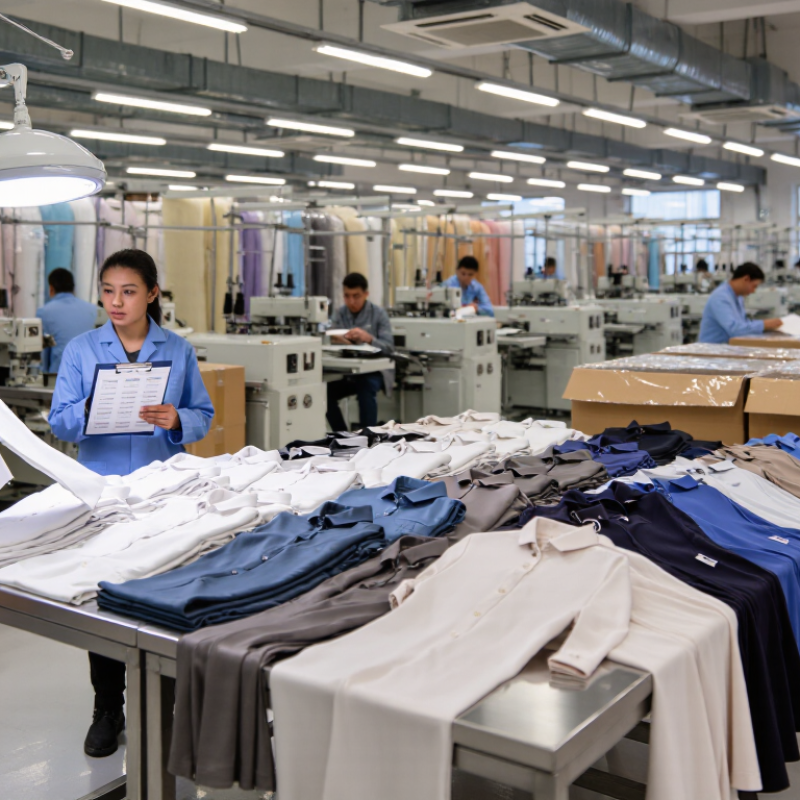
Top Blended Fabric Clothing Suppliers for Global Buyers

Types of Blended Fabrics Commonly Supplied to Global Buyers

Top Blended Fabric Clothing Suppliers for Global Buyers

Types of Blended Fabrics Commonly Supplied to Global Buyers

Blended fabrics combine fibers to balance comfort, strength, price, and care performance. Poly-cotton remains widely supplied for shirts, uniforms, and everyday workwear. Common ratios include 65% polyester and 35% cotton, or a balanced 50/50 construction. Polyester improves drying speed, while cotton adds softness and breathability.

Polyester-viscose blends are common in trousers, jackets, and office uniforms. Viscose gives a smoother hand feel and better drape. Polyester supports crease resistance and durability. Wool-polyester blends suit cooler climates and tailored garments. They can reduce cost and improve shape retention, although excessive polyester may reduce natural warmth.

Stretch fabrics also matter. Nylon-elastane and polyester-elastane blends support activewear, swimwear, and fitted clothing. Buyers should check recovery, pilling, colorfastness, and seam performance. Small percentages of elastane can change fit significantly. That detail is often underestimated.

Textile Exchange’s Materials Market Report 2024 recorded global fiber production at about 124 million tonnes in 2023. Polyester represented approximately 57% of total output, showing its importance in blended supply chains. The report also projects continued production growth through 2030. The Global Fashion Agenda and McKinsey’s Fashion CEO Agenda have repeatedly highlighted material efficiency and recycled inputs as key industry priorities.

Recycled polyester-cotton blends are increasingly requested, but claims require evidence. Suppliers should provide fiber composition tests, recycled-content documentation, and batch-level traceability. I have seen attractive samples fail after washing. Blending improves performance, but it does not solve every quality problem. White fabric can still yellow. Stretch can still weaken.

Key Criteria for Evaluating Blended Fabric Clothing Suppliers

Top Blended Fabric Clothing Suppliers for Global Buyers

Key Criteria for Evaluating Blended Fabric Clothing Suppliers

Global buyers need more than a low quoted price. A blended fabric supplier should prove performance through samples, test reports, and consistent production records. Ask for the exact fiber ratio, fabric weight, yarn type, and finishing process. A 65% polyester and 35% cotton blend can feel very different at 160 and 220 GSM. Request results for shrinkage, colorfastness, pilling, and seam strength. Test garments after washing, not only before shipment. This matters.

A practical evaluation also covers factory experience and communication. Can the supplier explain why a batch changed shade? Do technical staff answer with measurements, or vague promises? Reliable suppliers share production timelines, inspection checkpoints, and corrective action records. Independent audits can add confidence, but paperwork does not prove every shipment. That is easy to forget. Check whether recycled fibers have traceable documentation and whether product claims suit your target market.

Regional labeling, testing, and chemical requirements may differ. Confirm them with qualified local advisers. Do not accept “export quality” as a technical standard. It means little without defined tolerances. I would also score responsiveness, packaging details, and after-sales handling. A supplier may pass one sample and still struggle during peak capacity. Keep a small reserve order for verification. This extra step costs time. It can prevent larger losses.

Major Regions and Markets for Blended Garment Manufacturing

Blended garment manufacturing is concentrated where fiber access, technical labor, and export infrastructure overlap. China remains a broad sourcing base, especially for cotton-polyester uniforms, fleece, and performance basics. South Asia is strong in cotton-rich blends and large cut-and-sew programs. Its cost advantage can weaken when sampling, port delays, or quality corrections increase.

That detail matters. Southeast Asia offers competitive assembly and growing synthetic-fiber capacity.

Turkey and Eastern Europe serve nearby European markets with shorter transit times and smaller replenishment runs. They often suit buyers needing closer communication, flexible quantities, and seasonal response. North American buyers commonly compare Asian production with nearshore options in Central America.

The best choice depends on fabric development, order size, duty exposure, and delivery risk. I recommend checking yarn composition, colorfastness, pilling, shrinkage, needle quality, and seam strength before approval. Testing should use an independent laboratory when claims affect customer safety or product performance.

Market requirements also shape the blend. European buyers may request recycled-content evidence, chemical documentation, and stronger traceability. North American retailers often prioritize consistent sizing, packaging controls, and dependable replenishment.

In practice, a low factory price can hide expensive rework. I have seen promising samples fail after bulk washing. That was a useful warning.

Supplier reviews should include factory visits, production records, worker-safety checks, and realistic capacity data. No region performs perfectly. A careful buyer should leave room for that uncertainty.

Quality Control and Certification Standards for Global Orders

For global buyers, blended fabric suppliers should prove quality before production begins. A clear technical sheet should state fiber percentages, fabric weight, width, weave, and allowed tolerances. Small differences can affect fit, dye uptake, and production planning. Request a sealed sample and approve it in writing.

Quality control needs measurable checks. Inspectors can test fiber composition, GSM, shrinkage, colorfastness, pilling, seam strength, and fabric defects. For clothing, check measurements at several points, not only the first garment. An AQL-based final inspection may help control shipment risks, but it cannot replace process monitoring. Inline checks are useful when fabric rolls show uneven shade or tension marks.

Certification documents require careful review. ISO 9001 may support a documented quality system, while OEKO-TEX Standard 100 can address harmful substances in tested components. Recycled-content claims should include valid chain-of-custody records, where applicable. Certificates must match the factory, product scope, and current validity period. An accredited laboratory should conduct independent testing for sensitive orders. I have found that paperwork can look complete while the actual fabric differs from the approved sample. That weakness deserves attention. Keep test reports, inspection photos, batch numbers, and corrective-action records together. Clear records make supplier performance easier to verify across repeated global orders.

Top Blended Fabric Clothing Suppliers for Global Buyers - Quality Control and Certification Standards for Global Orders
Evaluation Dimension Applicable Standard or Control Point What Global Buyers Should Verify Relevant Blended-Fabric Risk Recommended Evidence Review Timing
Quality Management System ISO 9001:2015 Documented procedures for incoming inspection, production control, corrective action, traceability, and customer complaint handling. Inconsistent fiber ratios, uncontrolled process changes, and repeated defects across production lots. Valid certificate showing the correct legal entity and manufacturing scope; recent audit findings and corrective-action records. Before onboarding; annual review
Environmental Management ISO 14001:2015 Controls for energy, water, wastewater, chemicals, waste, and environmental legal compliance. Higher environmental impact from dyeing, finishing, and the separate processing requirements of different fibers. Current certificate, environmental objectives, wastewater records, chemical inventory, and permit documentation where applicable. Before onboarding; annual review
Recycled Fiber Claims Global Recycled Standard (GRS) Verification of recycled-material content, chain of custody, processing controls, and applicable social and environmental requirements. Incorrect recycled-content declarations or loss of material identity when recycled and virgin fibers are blended. Transaction certificates for the order, scope certificate for the facility, approved material specifications, and batch traceability records. For every certified order
Chemical Safety OEKO-TEX® STANDARD 100 Testing of finished textile components for harmful substances according to the relevant product class. Residual dyes, finishing agents, formaldehyde, or restricted substances may remain after blended-fabric processing. Valid certificate covering the exact product or component scope; independent laboratory report and approved chemical list. Per product family; renew as required
Restricted Substances Buyer RSL and applicable legal requirements Compliance with the buyer’s Restricted Substances List and destination-market requirements, such as limits on azo dyes, lead, cadmium, and certain phthalates. Different fibers and trims can introduce different chemical sources, especially elastane, prints, coatings, buttons, and labels. Signed supplier declaration, chemical formulation disclosure where permitted, and third-party test reports from an accredited laboratory. Every season and material change
Colorfastness to Washing ISO 105-C06 or AATCC TM61 Color change and staining after the specified laundering procedure, with test method and rating recorded in the report. Different fibers in a blend can absorb dye differently, causing shade change, staining, or cross-coloring after washing. Laboratory test report using the same fabric composition, dye lot, finish, and care instruction as the production order. Pre-production and bulk approval
Colorfastness to Crocking AATCC TM8 or ISO 105-X12 Dry and wet rubbing performance, including staining assessment under the selected test method. Dark shades, brushed surfaces, pigment prints, and uneven dye uptake can transfer color during handling or wear. Dry and wet crocking test results, shade standard, lab-dip approval, and bulk shade-band records. For dark or saturated colors
Dimensional Stability ISO 5077 with ISO 6330 or AATCC TM135 Length and width changes after the agreed washing and drying procedure. Cotton, polyester, viscose, and elastane can shrink or recover at different rates, creating distortion or seam torque. Before-and-after measurements, wash-care protocol, fabric relaxation records, and garment measurement report. Pre-production and bulk approval
Tensile Strength ISO 13934-1 or ASTM D5034 Breaking force in the warp and weft directions using a defined specimen and test procedure. Blending and finishing can reduce strength or create directional differences that affect garment durability. Independent test report identifying fabric construction, composition, direction, conditioning, and specimen results. Each new fabric construction
Abrasion Resistance ASTM D4966 or ISO 12947 Resistance to surface wear under the selected rubbing load, abradant, and endpoint. Soft finishes, raised surfaces, and blended yarns may pill, glaze, or lose appearance during repeated wear. Martindale or equivalent abrasion report, appearance photographs, and agreed buyer performance limit. For uniforms, workwear, and high-wear items
Pilling Resistance ISO 12945-2 or ASTM D4970 Surface fuzzing and pill formation after the specified rubbing cycles and rating system. Short fibers, yarn construction, fiber migration, and finishing can make blended fabrics prone to pilling. Test report with cycle count, rating scale, fabric face identification, and approved reference sample. For knitwear and brushed fabrics
Flammability and End-Use Safety Destination-market flammability requirements Applicable national or regional rules based on garment type, consumer age, intended use, and selling market. Fiber blends and surface finishes can change ignition behavior, flame spread, and melting characteristics. Country-specific test report, product classification, fiber-content declaration, and care-label review. Before shipment to each market
Social Compliance SA8000, SMETA, or equivalent buyer-approved audit Assessment of working hours, wages, health and safety, forced labor, child labor, discrimination, and grievance systems. Subcontracting, peak-season overtime, and outsourced dyeing or finishing may create unreported compliance exposure. Current audit report, corrective-action plan, worker interview summary, subcontractor list, and remediation evidence. Before onboarding; periodic follow-up
Occupational Health and Safety ISO 45001:2018 Risk assessment and controls for machinery, chemicals, fire safety, personal protective equipment, and emergency response. Cutting, sewing, dyeing, pressing, and chemical handling involve different workplace hazards across the supply chain. Certificate where applicable, fire inspection records, chemical safety data sheets, training logs, and incident records. Before onboarding; annual review
Pre-Shipment Inspection AQL-based sampling plan Inspection of workmanship, measurements, appearance, labeling, packaging, quantity, and shipment assortment using an agreed sampling level. Blended garments can show shade variation, composition-label errors, seam issues, and measurement instability between lots. Signed inspection report, defect photographs, measurement chart, packing-list reconciliation, and corrective-action record. Before every major shipment
Material Traceability Lot and batch identification Linkage between yarn, fabric, dye lot, trims, cutting tickets, production lines, finished garments, and shipment cartons. Fiber-ratio errors and shade differences are difficult to investigate when blended materials are not batch controlled. Purchase orders, batch cards, dye-lot records, cutting tickets, carton markings, and retained production samples. Every production order

How to Select and Work With a Blended Clothing Supplier

Selecting a blended clothing supplier starts with fabric evidence, not glossy photos. Ask for exact fiber ratios, GSM, yarn details, and test reports. A 60/40 cotton-polyester shirt can feel different after washing. Request several sample rounds. Measure shrinkage, pilling, colorfastness, and seam strength. Compare the approved sample with bulk fabric. Small differences matter. Check whether the factory controls knitting, dyeing, cutting, and sewing. Shared control can reduce delays, but it may limit flexibility. Review capacity honestly. A supplier promising every quantity may be less reliable than one explaining its limits.

Tips: Send a clear tech pack with tolerance ranges, target price, delivery window, and packaging details. Confirm the minimum order quantity before sampling. Ask who manages fabric risks when shade variation appears. Keep written approval records. Use a small pilot order. It reveals problems earlier, although it adds cost. Schedule video checks during production. Photos can hide uneven stitching.

A productive relationship needs clear milestones, inspection points, and payment terms. Discuss how the supplier handles rework, late materials, and rejected pieces. Verify labor, environmental, and product safety documents for your destination markets. Do not rely on certificates alone. Check their validity and scope. Communication speed is useful, but technical accuracy matters more. One imperfect sample should not end negotiations. It may expose a weak process, or simply unclear instructions. Review the cause before choosing another factory. Keep testing after approval, because blended fabrics can change between batches.

FAQS

What are the most common blended fabrics for global buyers?

Poly-cotton is widely used for shirts, uniforms, and everyday workwear. Common ratios include 65% polyester and 35% cotton, or 50/50. Polyester dries quickly. Cotton feels softer and more breathable.

Which blends suit trousers, jackets, and office uniforms?

Polyester-viscose blends offer smooth handling and better drape. Polyester improves crease resistance and durability. Wool-polyester blends suit cooler climates and tailored garments. Too much polyester may reduce natural warmth.

Which blended fabrics work well for stretch garments?

Nylon-elastane and polyester-elastane blends suit activewear, swimwear, and fitted clothing. Check stretch recovery, pilling, colorfastness, and seam performance. Small elastane percentages can change the fit significantly. This detail is easy to underestimate.

What fabric details should buyers request before ordering?

Request the exact fiber ratio, fabric weight, yarn type, and finishing process. A 65/35 blend can feel different at 160 and 220 GSM. Ask for shrinkage and seam-strength results. Measure carefully.

How should buyers test fabric quality?

Request samples and test reports before production. Wash the garments before approval. Check shrinkage, colorfastness, pilling, and seam strength afterward. Samples can mislead. I would not rely on appearance alone.

What evidence supports recycled-fiber claims?

Suppliers should provide fiber-composition tests, recycled-content documents, and batch-level traceability. Attractive samples may still fail after washing. Recycled content does not guarantee consistent quality. The paperwork needs checking.

How can buyers evaluate supplier reliability?

Ask how the supplier handles shade changes, delays, and production defects. Strong suppliers provide timelines, inspection checkpoints, and corrective-action records. Technical answers should include measurements. Vague promises are weak evidence.

What other risks should global buyers consider?

Confirm local labeling, testing, and chemical requirements with qualified advisers. “Export quality” is not a measurable standard without tolerances. Independent audits help, but paperwork cannot prove every shipment. Keep a small reserve order for verification.

Conclusion

This guide explores how global buyers can identify reliable Blended Fabric Clothing suppliers for different product requirements. It reviews commonly supplied materials such as cotton-polyester, cotton-spandex, viscose blends, recycled fiber combinations, and performance fabrics, explaining how each blend supports comfort, durability, stretch, moisture management, or cost efficiency. It also outlines key supplier evaluation criteria, including production capacity, technical expertise, communication, lead times, pricing transparency, and customization capabilities.

The article further examines major manufacturing regions and export markets, while highlighting the importance of quality control, material testing, ethical production practices, and recognized certifications. Buyers will learn how to compare suppliers, confirm samples, define specifications, manage inspections, and establish clear agreements for successful long-term cooperation. With a structured sourcing approach, companies can reduce risks, maintain consistent product quality, and develop dependable supply relationships for international garment orders.

Emma

Emma

Emma is a skilled marketing professional with a deep understanding of our company’s products and mission. With years of experience in the industry, she is adept at creating compelling content that not only engages our audience but also showcases the unique advantages of our offerings. Emma......