
Garment Manufacturing Insights
Stay Updated with Apparel Sourcing, Textile Innovations & Export Trends
How to Find the Best Bulk Garment Production in China?
Table of Contents
- Define Product Scope, MOQ, and Target Cost Before Sourcing
- Screen Chinese Factories Using 5+ Years’ Experience and ISO 9001 Evidence
- Compare Samples, 30–60-Day Lead Times, and MOQ of 100–500 Pieces
- Verify AQL 2.5 Quality Control, Materials, and Pre-Shipment Inspections
- Evaluate Quotes by Total Landed Cost, Compliance, and Production Capacity
- FAQS
- Conclusion
- Related Posts
Finding the right partner for Bulk Garment Production in China requires more than comparing factory prices. It demands practical research, clear specifications, and careful communication. A reliable supplier should understand your tech pack, fabric requirements, size grading, packaging needs, and target delivery dates. Ask for recent production examples. Inspect stitching, seam strength, fabric shrinkage, and color consistency. Small details reveal large problems.
Dilys Williams, founder of the Centre for Sustainable Fashion, has said, “Fashion is a powerful force for change.” Her observation matters when selecting a Chinese garment manufacturer. Large orders affect workers, resources, quality, and delivery networks. A responsible factory should explain its quality controls, labor practices, material sourcing, and production capacity without avoiding difficult questions. Factory certifications can help, but they should not replace independent verification.
Start with a written supplier brief. Include quantities, acceptable defect levels, fabric composition, labeling rules, and inspection stages. Request a prototype before approving bulk production. Then review a pre-production sample under natural and indoor light. Check measurements with a tape measure. Test washing when appropriate. Confirm payment terms and responsibilities in a clear contract.
No supplier scorecard is perfect. I have seen attractive samples hide weak finishing. Low prices can also conceal costly delays. Build a backup plan. Keep communication documented. Choose a manufacturer that answers precisely, admits limitations, and improves after feedback. The best Bulk Garment Production partner is not always the cheapest factory. It is the one that can repeat quality consistently, communicate honestly, and meet responsible production expectations.
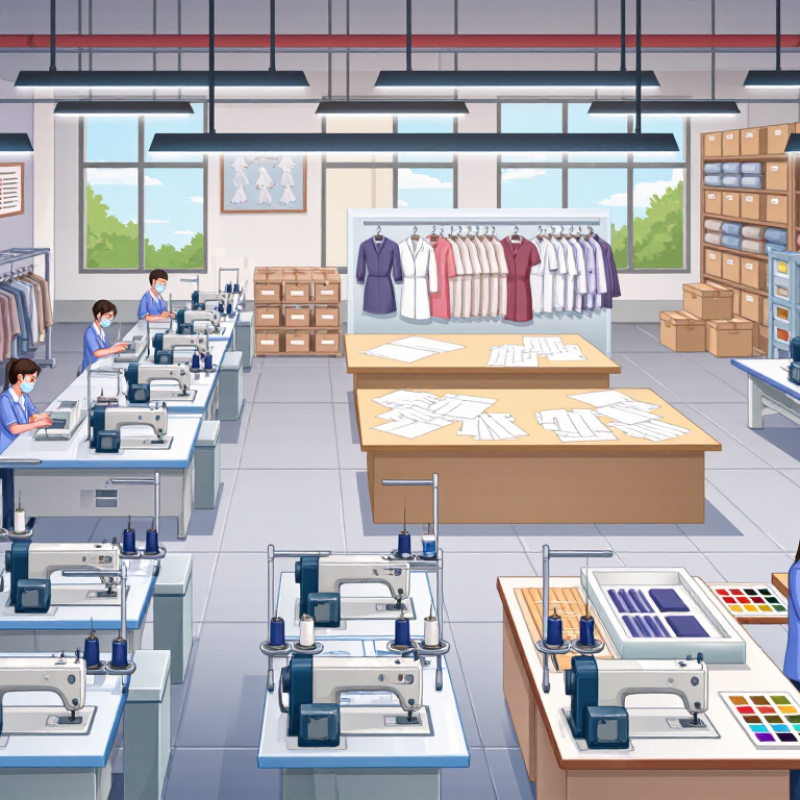
Define Product Scope, MOQ, and Target Cost Before Sourcing
Finding suitable bulk garment production in China starts before contacting factories. Define the product in measurable terms. Record fabric composition, weight, color standards, measurements, trims, stitching, packaging, and acceptable tolerances. A clear tech pack reduces vague quotations and protects quality discussions. Add reference photos, but never treat photos as complete specifications. Keep it measurable. Missing sleeve measurements often creates expensive sample revisions.
Set MOQ by style, color, and size range, not as one attractive total. Ask whether the factory counts mixed colors separately. A 500-piece MOQ may become 2,000 pieces after color and size requirements. Request a written breakdown for fabric minimums, cutting fees, sampling, and production capacity. Then compare factories using consistent assumptions. Factory visits can reveal cutting-room organization, inline inspection, and whether finished garments match approved samples. Remote checks help, but they do not replace physical verification.
Establish a target cost before negotiation. Include fabric, labor, trims, packaging, testing, freight, duties, and payment charges. Leave room for development and quality corrections. If a quotation is far below your target, ask what was excluded. Numbers expose gaps. One early estimate may fail. Fabric waste is often underestimated when patterns require directional cutting. Ask for a pre-production sample and detailed costing sheet before placing bulk orders. Confirm inspection standards, delivery milestones, and defect remedies in writing. A dependable supplier should explain limitations clearly, not promise everything.
Screen Chinese Factories Using 5+ Years’ Experience and ISO 9001 Evidence
Finding dependable bulk garment production in China requires more than comparing quotations. Screen factories with at least five years of verifiable operating history. Request business registration records, dated production photos, shipment records, and two recent buyer references. A long history shows experience, but it can also hide repeated process weaknesses.
ISO 9001 evidence adds a useful quality signal. The ISO Survey 2022 recorded more than 400,000 ISO 9001 certificates in China. However, a certificate does not guarantee perfect stitching or accurate sizing. Verify the certificate number with the certification body, then inspect its scope, expiry date, and manufacturing address. Ask for internal inspection records, corrective-action reports, and sample measurements. The 2024 Textile Exchange Materials Market Report estimated global fiber production at 124 million tonnes in 2023. This scale makes material traceability increasingly important, especially for recycled or certified fibers. Factory claims should match purchase records and supplier documents.
Tips: Visit the cutting room, sewing lines, and final inspection area. Count operators and inspect unfinished garments. Compare three samples from different production days. A factory may present its best line during an audit. That is where careful buyers can still misjudge capacity. Require a small trial order before committing to bulk production, and record defects by category, not emotion.
How to Find the Best Bulk Garment Production in China? - Screen Chinese Factories Using 5+ Years’ Experience and ISO 9001 Evidence
| Screening Dimension | Recommended Pass Benchmark | Acceptable Evidence | Suggested Weight | Screening Result |
|---|---|---|---|---|
| Operating History | At least 5 continuous years of garment manufacturing or export activity | Chinese business license, registration records, audited company profile, and historical export documentation | 15% | Pass / Verify |
| ISO 9001 Quality System | An active ISO 9001 certificate issued by an accredited certification body | Certificate number, validity dates, certification scope, issuing body, and online certificate verification | 20% | Pass / Reject |
| Certificate Scope | The ISO 9001 scope should cover clothing production, garment processing, or a directly relevant manufacturing activity | Exact wording shown on the certificate and matching factory address | 10% | Match / Recheck |
| Production Capacity | Verified monthly capacity should exceed the buyer’s forecasted monthly order volume by at least 20% | Production-line list, number of operators, working hours, recent capacity records, and factory video audit | 15% | Pass / Clarify |
| Quality Control Process | Documented incoming, in-line, and final inspection procedures | Inspection checklists, defect classification rules, corrective-action reports, and retained inspection records | 15% | Pass / Improve |
| Pre-Shipment Inspection | A documented sampling plan agreed before production; AQL 2.5 for major defects and AQL 4.0 for minor defects may be used as a buyer-defined benchmark | Inspection report, sample size, defect photos, acceptance criteria, and independent inspection option | 10% | Pass / Negotiate |
| Material Traceability | Fabric, trims, dye lots, purchase orders, and finished goods should be traceable by batch | Material records, batch labels, supplier invoices, test reports, and warehouse procedures | 8% | Pass / Verify |
| Sample and Bulk Consistency | Approved sample, size chart, color standard, construction details, and packaging specification must be documented before bulk production | Signed pre-production sample, measurement report, approved artwork, and sealed reference sample | 7% | Pass / Control |
| Compliance and Workplace Safety | No unresolved critical findings involving forced labor, child labor, fire safety, or wage violations | Recent social-compliance audit, fire-safety records, worker documentation, and corrective-action closure evidence | 10% | Pass / Reject |
| Commercial Reliability | Written quotation, payment terms, production timeline, defect-remedy terms, and shipment responsibilities should be clearly defined | Signed quotation, purchase agreement, production schedule, communication records, and reference order documentation without confidential buyer details | 10% | Pass / Clarify |
| Recommended Selection Rule | Minimum 75 / 100 | No critical evidence gaps | ||
Use the benchmarks as buyer-defined screening criteria. Verify certificates, legal records, factory capacity, inspection documents, and audit findings independently before placing a bulk order.
Compare Samples, 30–60-Day Lead Times, and MOQ of 100–500 Pieces
China remains a major apparel sourcing base. The WTO World Trade Statistical Review 2024 reports that China supplied about 31% of global textile and clothing exports in 2023. That scale does not guarantee a suitable factory. Request two or three samples using your actual fabric, labels, stitching, and wash instructions. Check shrinkage, color consistency, seam strength, and measurement tolerance under bright light. Sample approval must be written. Verbal approval causes expensive confusion.
For 100–500 pieces, MOQ may be negotiable, but fabric mills can require higher minimums. Request a line-by-line MOQ for color, size, style, and fabric. HKTDC Research highlights flexible orders as important for changing fashion demand. Flexibility can still increase unit cost. Compare landed cost, not only the factory quote. Ask whether sampling, grading, packaging, and inspection fees are included.
A realistic production window is 30–60 days after deposit, sample approval, and material confirmation. Build a dated schedule for cutting, sewing, finishing, inspection, and shipment. Deloitte’s 2024 Global Chief Procurement Officer Survey documents continuing supply-chain volatility. Keep several buffer days. Do not trust a perfect promise. My practical mistake was counting from the purchase order date; material approval added twelve days. Reconfirm capacity before payment, especially near 500 pieces.
Verify AQL 2.5 Quality Control, Materials, and Pre-Shipment Inspections
Reliable bulk garment production starts with a measurable inspection plan, not attractive samples alone.
Request an AQL 2.5 inspection based on ISO 2859-1 sampling procedures. AQL 2.5 does not mean 2.5% of garments may be defective. It defines an acceptance level within a statistical sample. Critical defects should remain unacceptable. Major and minor defects need separate limits.
Inspect materials before cutting.
Check fiber composition, fabric weight, width, color shade, shrinkage, and tear strength. Textile Exchange’s Materials Market Report 2024 states that global fiber production reached 124 million tonnes in 2023. It may reach 160 million tonnes by 2030. This scale increases the importance of traceable material records and consistent testing. A fabric roll can look perfect under factory lighting, then change after washing. Request lab reports and compare them with physical samples.
Do not rely on factory photographs.
During pre-shipment inspection, confirm production is substantially complete and packed for export. Inspect measurements, stitching, labels, carton quantities, needle damage, stains, and color consistency. Photograph defects beside a ruler. Record carton numbers and sample sizes. A final inspection cannot repair poor cutting. It can expose the problem before shipment. That distinction matters.
Small gaps remain possible.
AQL sampling does not inspect every garment. For high-risk styles, add in-line inspections and 100% checks for critical features. Experienced buyers also review recurring defects, not only the final pass or fail result. A clean report is useful, but production evidence is stronger.
Evaluate Quotes by Total Landed Cost, Compliance, and Production Capacity
How to Find the Best Bulk Garment Production in China?
A competitive quote is not the cheapest factory price. It is the lowest reliable total landed cost. Compare fabric, trims, sampling, inspection, inland trucking, ocean freight, insurance, duties, testing, and payment fees. Ask whether the quote is EXW, FOB, or another trade term. The difference can be substantial. The World Bank’s Logistics Performance Index 2023 ranked China 19th, with a score of 3.7 out of 5. Efficient logistics help, but they do not remove port delays or seasonal rate increases.
Request a cost sheet with fixed and variable charges shown separately. Then test the price against two shipment scenarios. One normal. One delayed. Include rework, rejected units, and possible air freight. That uncomfortable exercise often exposes unrealistic margins. Review the factory’s recent production records, available lines, monthly capacity, and peak-season commitments. Capacity claims without production evidence deserve caution.
Compliance should be checked before signing. Request current social, safety, environmental, and chemical-control records. The OECD Due Diligence Guidance for Responsible Supply Chains in the Garment and Footwear Sector recommends risk-based supplier assessment and traceable corrective actions. WTO data showed China supplied roughly one-third of global clothing exports in 2022, proving its manufacturing scale, but scale does not guarantee consistency. A supplier may pass one audit and still miss delivery targets. Keep a reserve supplier, verify corrective actions on-site, and link payment milestones to measurable production and inspection results.
How to Find the Best Bulk Garment Production in China?
Evaluate each quote by total landed cost, compliance readiness, and production capacity—not by unit price alone.
Total landed cost includes the quoted garment price, international freight, import duty, inspection, and handling. A stronger production option combines a lower landed cost with a high compliance score and sufficient monthly capacity.
FAQS
Record fabric composition, weight, color standards, measurements, trims, stitching, packaging, and tolerances. Add reference photos, but keep measurements precise. Photos are incomplete.
It reduces vague quotations and limits costly misunderstandings. Missing sleeve measurements can cause expensive sample revisions. I would check every measurement twice.
Calculate MOQ by style, color, and size range. A 500-piece total may become 2,000 pieces after color separation. Request the breakdown in writing.
Include fabric, labor, trims, packaging, testing, freight, duties, payment charges, and development costs. One early estimate may fail. Leave correction room.
Ask what the quotation excludes. Fabric waste, cutting fees, testing, or packaging may be missing. Low numbers need careful questioning.
It defines an acceptance level for a statistical sample. It does not mean 2.5% of garments may be defective. Critical defects should remain unacceptable.
Check fiber composition, fabric weight, width, color shade, shrinkage, and tear strength. Compare laboratory reports with physical fabric samples. Lighting can mislead.
Check measurements, stitching, labels, carton quantities, needle damage, stains, and color consistency. Photograph defects beside a ruler. Record carton numbers and sample sizes.
No. Sampling does not inspect every garment, and final checks cannot repair poor cutting. High-risk styles may need inline inspections and critical-feature checks.
Confirm the pre-production sample, costing sheet, inspection standards, delivery milestones, and defect remedies in writing. Promises are not enough. Keep evidence.
Conclusion
Finding reliable Bulk Garment Production in China begins with clear preparation. Define your product range, fabric requirements, expected order quantity, target cost, and quality standards before contacting factories. Prioritize manufacturers with at least five years of relevant experience and request evidence of ISO 9001 systems or comparable quality procedures. Compare multiple suppliers by reviewing samples, communication, production capacity, minimum order quantities of approximately 100–500 pieces, and realistic lead times of 30–60 days.
Before placing an order, verify material specifications, workmanship, labeling requirements, and quality-control procedures. An AQL 2.5 inspection standard can provide a practical benchmark, while independent pre-shipment inspections help identify defects before goods leave the factory. When comparing quotations, look beyond the unit price and calculate the total landed cost, including packaging, transportation, inspection, duties, and other expenses. A supplier that combines consistent quality, transparent compliance practices, dependable capacity, and clear communication will usually offer better long-term value than the lowest-priced option.
Blog Tags: