
Garment Manufacturing Insights
Stay Updated with Apparel Sourcing, Textile Innovations & Export Trends
China remains a major sourcing base for garment accessories, from buttons and zippers to labels, elastic, and interlinings. For apparel brands, choosing a dependable Garment Accessories Exporter can affect product quality, delivery schedules, and production costs. Samples matter. This overview introduces ten Chinese exporters and explains what buyers should examine before requesting quotations. Company capabilities vary widely. Some suppliers focus on specific trims, while others offer broad catalogs, custom development, or coordinated packaging. That difference matters.
A practical comparison should look beyond catalog photos. Check product specifications, material options, minimum order quantities, sample lead times, export experience, and communication quality. Ask for clear details about color matching, testing documents, packaging, and production capacity. Where available, confirm business information through company records and recent customer references. No directory can guarantee a perfect fit. Supplier information changes, and online claims may not reflect current production capabilities. Treat this list as a starting point, not a final endorsement. Request physical samples and compare them under the lighting used for your garments. A zipper can look right on screen yet feel rough in hand. Even careful checks have limits. The strongest choice depends on your design, budget, order volume, and tolerance for risk. This guide aims to support more informed decisions, while recognizing that some details still require direct verification.
What Garment Accessories Include in China’s Export Industry
China Top 10 Garment Accessories Exporters
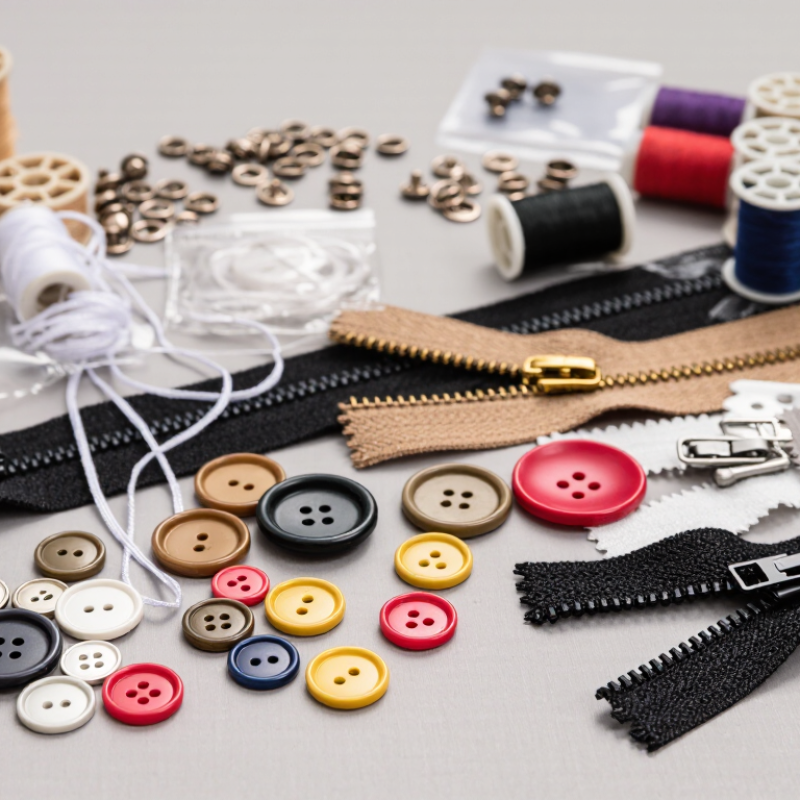
Garment accessories are the small components that help clothing function, fit, and look finished. In China’s export industry, this category commonly includes buttons, zippers, snaps, hooks, sewing thread, elastic, lace, labels, and interlining. Some suppliers also handle cords, buckles, patches, and packaging materials. Small details matter.
A shirt button may need consistent sizing and color across thousands of pieces. A zipper must run smoothly, while elastic needs to recover after stretching. Exporters therefore coordinate material selection, samples, color matching, and inspection before goods are packed. Buyers often check measurements, stitching strength, shade differences, and how trims perform after washing. These checks can prevent costly production delays.
The category is not always tidy. One supplier may make components, while another sources several kinds of trims and arranges export packing. This makes clear specifications especially useful: send a physical sample, state the required finish, and confirm tolerances in writing. A photo alone may not show texture or true color. Even experienced buyers can overlook small differences. That is worth remembering.
China Top 10 Garment Accessories Exporters - What Garment Accessories Include in China’s Export Industry
| No. | Garment accessory product group | Relevant HS heading(s) | Typical apparel use | Export-industry context |
|---|---|---|---|---|
| 1 | Buttons and snap fasteners | 9606 | Closures and decorative details on shirts, coats, trousers, and uniforms. | The heading covers buttons, press-fasteners, snap-fasteners, and their parts; materials can include plastic and base metal. |
| 2 | Slide fasteners (zippers) | 9607 | Closures for jackets, jeans, dresses, bags, and workwear. | The HS heading includes slide fasteners and their parts. |
| 3 | Hooks, eyes, eyelets, and garment clasps | 8308 | Fastening and reinforcement components for clothing, footwear, and accessories. | This heading covers specified base-metal fittings, including hooks, eyes, eyelets, and certain clasps used for clothing or accessories. |
| 4 | Textile labels and badges | 5807 | Care, size, and origin labels, plus textile badges and similar identifiers. | The heading covers textile labels, badges, and similar articles that are not embroidered. |
| 5 | Narrow woven fabrics and tapes | 5806 | Waistbands, binding, straps, edging, and other narrow garment trims. | The heading covers qualifying narrow woven fabrics, subject to its product definitions and exclusions. |
| 6 | Lace and net trimming | 5804 | Decorative panels, edging, and inserts for dresses, lingerie, and occasionwear. | The heading includes lace in the piece, in strips, or in motifs, as well as specified tulle and net fabrics. |
| 7 | Embroidery and embroidered motifs | 5810 | Decorative logos, emblems, patches, and designs applied to garments. | The heading covers embroidery in the piece, in strips, or in motifs. |
| 8 | Braids and ornamental textile trimmings | 5808 | Decorative cords, braids, tassels, and similar finishing details. | The heading covers specified braids and ornamental trimmings in the piece, excluding embroidered and knitted or crocheted goods. |
| 9 | Sewing thread | 5204 (cotton); 5401 (man-made filaments) | Stitching seams and attaching components during garment production. | Classification depends on fibre and product specifications; these headings cover cotton and specified man-made filament sewing thread. |
| 10 | Elastic textile bands and fabrics | 5806 (certain woven fabrics); 6002 (certain knitted or crocheted fabrics) | Waistbands, cuffs, lingerie bands, and stretch sections in apparel. | Classification depends on construction and product details; the headings shown cover different types of narrow or elastic textile fabrics. |
Note: This table lists garment-accessory product groups, not ranked companies or brands. The numbers are for reference only and do not represent verified export-value rankings. HS headings are international product classifications; exact tariff codes can vary by product specifications and the importing country’s tariff schedule.
FAQS
It works as a production network. Specialized factories make zippers, buttons, labels, elastic, lace, or woven tapes. Workshops, trading firms, and logistics providers handle other steps. One order may involve several suppliers. Handoffs can get messy.
Manufacturers sell their own output and may control production more closely. Sourcing-oriented firms combine products from multiple factories, which can simplify mixed orders. Neither structure guarantees consistent quality.
Review material specifications, sample records, inspection routines, and packing details. Ask how defects are traced and who handles corrective action. The answer may reveal gaps that a polished catalogue does not.
Compare recent inspection records with samples and bulk-production samples. Check color, size, material, and batch details. Use the same lighting when comparing colors. Even then, a shade difference can slip through.
Match stated capacity against a real order schedule. Ask for documented defect rates, sample lead times, and on-time delivery figures. Contact recent customers with permission. Peak-season performance matters.
A small trial can test repeatability, packing, and delivery before larger volumes are committed. One successful sample proves little. A trial helps, though it cannot predict every disruption.
China’s textile-and-apparel exports reached about US$301.1 billion in 2024, up 2.8% year on year. This is a broad sector figure, not an accessories-only total. The distinction matters.
Route disruptions and longer voyages can raise shipping costs and change delivery estimates. Buyers should ask for clear schedules and updates. A neat estimate can still prove optimistic.
Conclusion
This article explores the role of garment accessories in China’s export industry, covering products such as buttons, zippers, labels, fasteners, linings, and decorative components. It explains how the sector is organized, from specialized manufacturers and material suppliers to sourcing and export services. Readers will also learn how to assess a Garment Accessories Exporter by considering product range, production capacity, quality consistency, customization options, communication, and delivery reliability.
The article profiles ten leading exporters through a practical, category-focused overview rather than a brand ranking, highlighting the different capabilities suppliers may offer. It also examines key export markets and industry trends, including demand for flexible customization, efficient production, and more responsible sourcing. Together, these topics provide buyers with a clear framework for understanding China’s garment accessories supply landscape and identifying suppliers that suit their product and sourcing needs.